Struggling to find a CNC supplier you can trust? Bad parts and missed deadlines can derail your entire project. Choosing the right partner is the most important step for success.
To choose a reliable CNC machining supplier, you must find one that matches your project's needs. This means evaluating their technical capabilities, communication skills, and quality control systems. A true partner provides proactive DFM feedback and is a good fit for your production volume, whether it's for prototypes or low-volume runs.
Choosing a supplier is not just about finding the lowest price. It is about building a relationship with a partner who understands your design and your goals. A great supplier helps you move faster and avoid costly mistakes. So, let's break down the key things you need to look for to find a partner you can count on.
Should you partner with a large manufacturer or a smaller machine shop?
Are you confused about choosing between a big factory and a smaller, agile shop? Making the wrong choice can lead to high costs or poor quality. Understanding their differences helps you find the perfect fit.
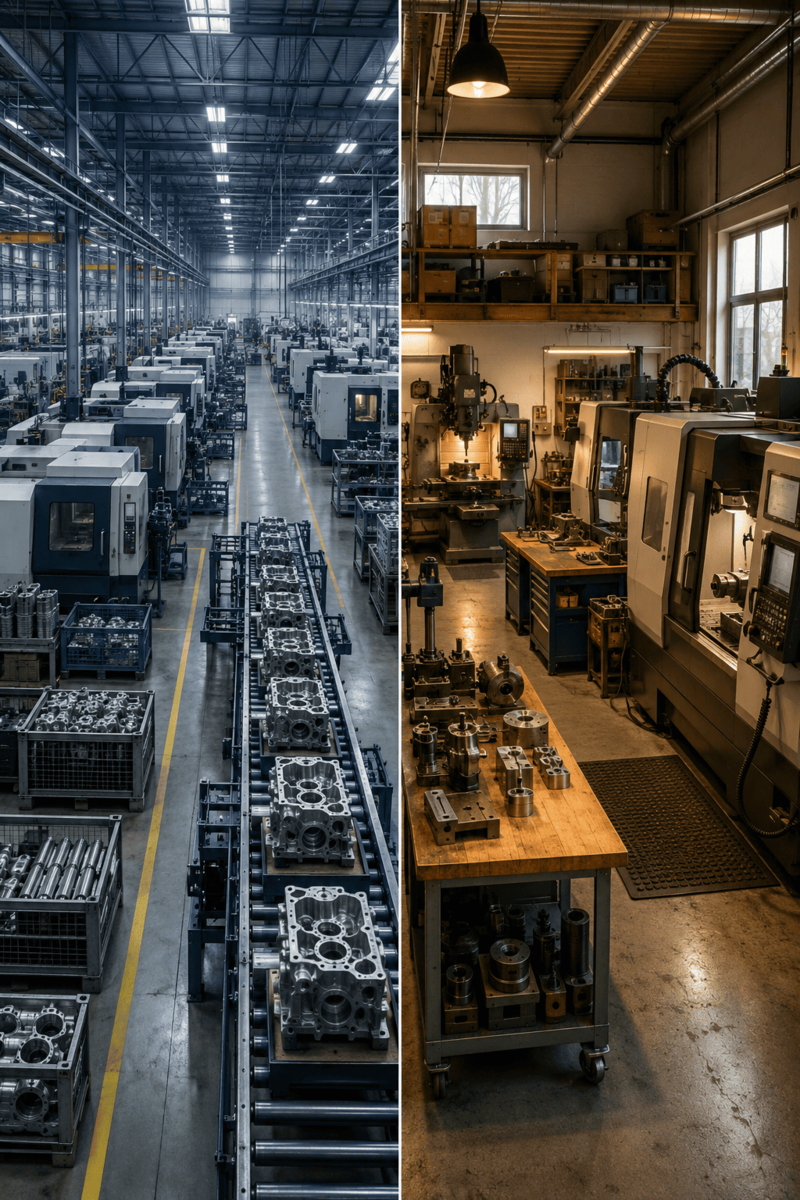
Large manufacturers are great for mass production but can be expensive and slow for smaller projects. Specialized machine shops offer more flexibility, faster responses, and better costs for prototypes and low-to-medium volume production, making them ideal for innovative companies.
Choosing between a giant corporation and a focused machine shop is a critical decision. I have worked with both types of suppliers, and the experience is worlds apart. Your choice should directly align with your project's scale, budget, and speed requirements.
The Case for Large Manufacturers
Large manufacturers have impressive systems and are built for one thing: high-volume production. If you need to produce 50,000 units of a finalized design, they are a solid choice. Their processes are standardized to ensure consistency across massive quantities. However, this size and structure create problems for R&D projects. Their sales and engineering teams are often disconnected, leading to slow quote times. I once waited over a week just to get a price for a simple bracket. Their high overhead costs also mean you pay a premium, and they usually require a high Minimum Order Quantity (MOQ).
The Advantage of Specialized Machine Shops
This is where smaller, specialized shops like ours provide a better solution for hardware innovators. We are built for speed and flexibility. When you are developing a new product, you need to iterate quickly. A smaller shop allows you to communicate directly with the engineers who will actually machine your parts. This direct line of communication is invaluable. We can provide feedback in hours, not days. Our leaner structure also means our pricing is much more competitive, especially for prototypes and runs of 1 to 1,000 pieces.
Here is a simple table to help you decide:
| Feature | Large Manufacturer | Specialized Machine Shop |
|---|---|---|
| Best For | Mass Production (>10,000 pcs) | Prototypes & Low-Volume (1-5,000 pcs) |
| Price | Higher | Competitive |
| Response Time | Slow | Fast (e.g., 24-hour RFQs) |
| Flexibility | Low | High |
| Communication | Formal, Slow | Direct, Fast |
For an R&D engineer under pressure to launch a product, a dedicated, agile partner is almost always the better choice.
What technical capabilities really matter for your project?
Are you worried that a potential supplier cannot handle your complex design? Limited machine capabilities can lead to compromised parts and serious production delays. Verifying their technical skills and equipment is crucial for success.
Look beyond just the number of machines. Key capabilities include simultaneous 3, 4, and 5-axis machining for complex geometries, deep expertise in a wide range of materials, and in-house surface finishing services. These ensure end-to-end quality control and faster lead times.
A supplier's website might list dozens of machines, but that doesn't tell you the whole story. The right technical capabilities mean they can not only make your part but make it well, efficiently, and to your exact specifications. It’s about having the right tools and the right knowledge.
Beyond Basic Milling and Turning
Most shops can do basic 3-axis machining. But modern products often have complex curves and features that require more advanced technology. This is where 4-axis and 5-axis CNC machining become essential. A 5-axis machine can move a part or the cutting tool along five different axes at the same time. This allows us to machine intricate shapes in a single setup. For a client in the medical device industry, we used 5-axis machining to create a complex housing with curved surfaces and deep pockets. A 3-axis shop would have needed multiple setups, increasing the risk of errors and driving up the cost. For parts with very fine details, technologies like Wire EDM and Sinker EDM are also important.
Material Expertise Is Key
Your part is only as good as the material it is made from. A good supplier should have experience with a wide variety of materials, not just a couple of types of aluminum. We regularly work with everything from common metals like Aluminum 6061 and Stainless Steel 304 to more exotic options like Titanium and Copper. We also machine a lot of engineering plastics like PEEK, which is popular for medical applications, and POM (Delrin) for high-wear parts. This experience means we understand how each material behaves during machining and can select the right tools and cutting speeds to achieve the best results.
The Value of One-Stop Finishing Services
Many machine shops outsource their surface finishing, like anodizing, powder coating, or plating. This adds time, cost, and risk to your project. Every time the parts leave the shop, there's a chance they could get lost, damaged, or finished incorrectly. I remember a horror story from a client whose previous supplier outsourced sandblasting. The parts came back with a ruined surface finish, and a week was lost. That is why having comprehensive finishing services in-house is a huge advantage. We can machine a part, deburr it, send it for anodizing, and then laser-mark it, all under one roof. This gives us complete control over the quality and schedule, from raw material to finished product.
Why are communication and DFM feedback non-negotiable?
Are you frustrated by suppliers who do not seem to understand your technical drawings? Misinterpretations and communication gaps lead to expensive scrap parts and wasted time. Proactive communication is the sign of a true manufacturing partner.
Effective communication is more than just speaking English; it is about a deep understanding of GD&T and technical requirements. A reliable supplier provides proactive Design for Manufacturability (DFM) feedback to optimize your design, prevent problems, and reduce costs before production even begins.
I cannot stress this enough: communication is everything. A cheap price from a supplier who doesn’t understand your intent will end up costing you more in the long run. A great supplier acts as an extension of your own engineering team. They ask smart questions and help you make your design even better.
Speaking the Same Engineering Language
When you send a drawing with GD&T callouts, you need your supplier to understand exactly what they mean. A misunderstanding of a position tolerance or a surface profile can result in a part that doesn't fit or function correctly. This is a common problem when working with suppliers who lack experienced engineers or rely solely on salespeople to handle technical details. At our shop, our project managers are also engineers. We review every drawing carefully to ensure we understand every dimension, tolerance, and note. This shared technical language prevents errors before a single piece of metal is cut.
The Power of Proactive DFM
The best time to fix a manufacturing problem is during the design phase. A proactive supplier will give you DFM feedback for free. This is a report that analyzes your design and suggests changes to make it easier and cheaper to machine, without compromising its function. For example, a new client recently sent us a design with sharp internal corners, which would have required slow and expensive EDM work. We sent back a DFM report suggesting they add a small radius in those corners. This allowed us to use a standard end mill, which cut the machining time in half and reduced their cost by 25%. That’s the power of a true partnership. It's not about just taking an order; it's about working together to achieve the best outcome.
Protecting Your Intellectual Property
When you send your CAD files to a supplier, you are trusting them with your valuable intellectual property (IP). This is a major concern for innovative companies. A reliable supplier must have a formal process to protect your data. The first step should always be a Non-Disclosure Agreement (NDA). We have a standardized NDA process and treat all client data with the highest level of security. Our internal servers are protected, and access to client files is strictly limited to the team working on the project. You should never work with a supplier who is casual about IP protection.
Conclusion
Choosing a CNC supplier is about finding a partner that matches your needs in scale, technical skill, and communication. A good partner accelerates your path from design to market.
Struggling to find a CNC supplier you can trust? Bad parts and missed deadlines can derail your entire project. Choosing the right partner is the most important step for success[^1].
To choose a reliable CNC machining supplier, you must find one that matches your project's needs. This means evaluating their technical capabilities, communication skills, and quality control systems. A true partner provides proactive DFM feedback and is a good fit for your production volume, whether it's for prototypes or low-volume runs.
Choosing a supplier is not just about finding the lowest price. It is about building a relationship with a partner who understands your design and your goals. A great supplier helps you move faster and avoid costly mistakes. So, let's break down the key things you need to look for to find a partner you can count on.
Should you partner with a large manufacturer or a smaller machine shop?
Are you confused about choosing between a big factory and a smaller, agile shop? Making the wrong choice can lead to high costs or poor quality. Understanding their differences helps you find the perfect fit.
Large manufacturers are great for mass production but can be expensive and slow for smaller projects[^2]. Specialized machine shops offer more flexibility, faster responses, and better costs for prototypes and low-to-medium volume production[^3], making them ideal for innovative companies.
Choosing between a giant corporation and a focused machine shop is a critical decision. I have worked with both types of suppliers, and the experience is worlds apart. Your choice should directly align with your project's scale, budget, and speed requirements.
The Case for Large Manufacturers
Large manufacturers have impressive systems and are built for one thing: high-volume production. If you need to produce 50,000 units of a finalized design, they are a solid choice. Their processes are standardized to ensure consistency across massive quantities. However, this size and structure create problems for R&D projects. Their sales and engineering teams are often disconnected, leading to slow quote times. I once waited over a week just to get a price for a simple bracket. Their high overhead costs also mean you pay a premium, and they usually require a high Minimum Order Quantity (MOQ)[^4].
The Advantage of Specialized Machine Shops
This is where smaller, specialized shops like ours provide a better solution for hardware innovators. We are built for speed and flexibility. When you are developing a new product, you need to iterate quickly. A smaller shop allows you to communicate directly with the engineers who will actually machine your parts. This direct line of communication is invaluable. We can provide feedback in hours, not days. Our leaner structure also means our pricing is much more competitive, especially for prototypes and runs of 1 to 1,000 pieces.
Here is a simple table to help you decide:
| Feature | Large Manufacturer | Specialized Machine Shop |
|---|---|---|
| Best For | Mass Production (>10,000 pcs) | Prototypes & Low-Volume (1-5,000 pcs) |
| Price | Higher | Competitive |
| Response Time | Slow | Fast (e.g., 24-hour RFQs) |
| Flexibility | Low | High |
| Communication | Formal, Slow | Direct, Fast |
For an R&D engineer under pressure to launch a product, a dedicated, agile partner is almost always the better choice.
What technical capabilities really matter for your project?
Are you worried that a potential supplier cannot handle your complex design? Limited machine capabilities can lead to compromised parts and serious production delays. Verifying their technical skills and equipment is crucial for success.
Look beyond just the number of machines. Key capabilities include simultaneous 3, 4, and 5-axis machining[^5] for complex geometries, deep expertise in a wide range of materials, and in-house surface finishing services. These ensure end-to-end quality control and faster lead times.
A supplier's website might list dozens of machines, but that doesn't tell you the whole story. The right technical capabilities mean they can not only make your part but make it well, efficiently, and to your exact specifications. It’s about having the right tools and the right knowledge.
Beyond Basic Milling and Turning
Most shops can do basic 3-axis machining. But modern products often have complex curves and features that require more advanced technology. This is where 4-axis and 5-axis CNC machining become essential. A 5-axis machine can move a part or the cutting tool along five different axes at the same time. This allows us to machine intricate shapes in a single setup[^6]. For a client in the medical device industry, we used 5-axis machining to create a complex housing with curved surfaces and deep pockets. A 3-axis shop would have needed multiple setups, increasing the risk of errors and driving up the cost. For parts with very fine details, technologies like Wire EDM and Sinker EDM[^7] are also important.
Material Expertise Is Key
Your part is only as good as the material it is made from. A good supplier should have experience with a wide variety of materials, not just a couple of types of aluminum. We regularly work with everything from common metals like Aluminum 6061 and Stainless Steel 304 to more exotic options like Titanium and Copper. We also machine a lot of engineering plastics like PEEK, which is popular for medical applications[^8], and POM (Delrin) for high-wear parts. This experience means we understand how each material behaves during machining and can select the right tools and cutting speeds to achieve the best results.
The Value of One-Stop Finishing Services
Many machine shops outsource their surface finishing, like anodizing, powder coating, or plating. This adds time, cost, and risk to your project[^9]. Every time the parts leave the shop, there's a chance they could get lost, damaged, or finished incorrectly. I remember a horror story from a client whose previous supplier outsourced sandblasting. The parts came back with a ruined surface finish, and a week was lost. That is why having comprehensive finishing services in-house is a huge advantage. We can machine a part, deburr it, send it for anodizing, and then laser-mark it, all under one roof. This gives us complete control over the quality and schedule, from raw material to finished product.
Why are communication and DFM feedback non-negotiable?
Are you frustrated by suppliers who do not seem to understand your technical drawings? Misinterpretations and communication gaps lead to expensive scrap parts and wasted time. Proactive communication is the sign of a true manufacturing partner.
Effective communication is more than just speaking English; it is about a deep understanding of GD&T[^10] and technical requirements. A reliable supplier provides proactive Design for Manufacturability (DFM)[^11] feedback to optimize your design, prevent problems, and reduce costs before production even begins.
I cannot stress this enough: communication is everything. A cheap price from a supplier who doesn’t understand your intent will end up costing you more in the long run. A great supplier acts as an extension of your own engineering team. They ask smart questions and help you make your design even better.
Speaking the Same Engineering Language
When you send a drawing with GD&T callouts, you need your supplier to understand exactly what they mean. A misunderstanding of a position tolerance or a surface profile can result in a part that doesn't fit or function correctly. This is a common problem when working with suppliers who lack experienced engineers or rely solely on salespeople to handle technical details. At our shop, our project managers are also engineers. We review every drawing carefully to ensure we understand every dimension, tolerance, and note. This shared technical language prevents errors before a single piece of metal is cut.
The Power of Proactive DFM
The best time to fix a manufacturing problem is during the design phase. A proactive supplier will give you DFM feedback for free. This is a report that analyzes your design and suggests changes to make it easier and cheaper to machine, without compromising its function. For example, a new client recently sent us a design with sharp internal corners, which would have required slow and expensive EDM work. We sent back a DFM report suggesting they add a small radius in those corners. This allowed us to use a standard end mill, which cut the machining time in half and reduced their cost by 25%. That’s the power of a true partnership. It's not about just taking an order; it's about working together to achieve the best outcome.
Protecting Your Intellectual Property
When you send your CAD files to a supplier, you are trusting them with your valuable intellectual property (IP). This is a major concern for innovative companies. A reliable supplier must have a formal process to protect your data. The first step should always be a Non-Disclosure Agreement (NDA)[^12]. We have a standardized NDA process and treat all client data with the highest level of security. Our internal servers are protected, and access to client files is strictly limited to the team working on the project. You should never work with a supplier who is casual about IP protection.
Conclusion
Choosing a CNC supplier is about finding a partner that matches your needs in scale, technical skill, and communication. A good partner accelerates your path from design to market.
[^1]: "Assessing the Best Supplier Selection Criteria in Supply Chain ...", https://pmc.ncbi.nlm.nih.gov/articles/PMC9102987/. Research in supply chain management and manufacturing indicates a strong correlation between strategic supplier selection and key project success metrics, including cost control, lead time reduction, and overall product quality. Evidence role: general_support; source type: paper. Supports: The claim that supplier selection is a critical factor for project success in manufacturing.. Scope note: The source may not state that it is 'the most important' step, but it will support its high level of importance. [^2]: "Economies of scale - Wikipedia", https://en.wikipedia.org/wiki/Economies_of_scale. Economic principles of manufacturing show that large-scale facilities, optimized for high-volume production through economies of scale, often have high fixed overhead and significant setup costs, making them less cost-effective and slower to re-tool for small, custom production runs. Evidence role: mechanism; source type: education. Supports: The claim that large manufacturers are often more expensive and slower for small projects.. [^3]: "Why Agile Engineering is the Future of Product Design - Formlabs", https://formlabs.com/eu/blog/agile-engineering-product-development/. Studies on agile manufacturing and small to medium-sized enterprises (SMEs) often highlight their structural advantages for low-volume and prototype production, including greater operational flexibility, lower overhead costs, and faster communication cycles compared to larger manufacturers. Evidence role: general_support; source type: paper. Supports: The claim that smaller, specialized shops are advantageous for low-volume production.. [^4]: "Minimum Order Quantity (MOQ): Formula, Tips, & Benefits | NetSuite", https://www.netsuite.com/portal/resource/articles/inventory-management/minimum-order-quantity-moq.shtml. A Minimum Order Quantity (MOQ) is the fewest number of units a business is willing to sell to a single customer at once. Manufacturers use MOQs to cover their fixed production and transaction costs, ensuring they achieve a minimum profit on a production run. Evidence role: definition; source type: encyclopedia. Supports: The definition of Minimum Order Quantity (MOQ) and its use by large manufacturers.. [^5]: "Multiaxis machining - Wikipedia", https://en.wikipedia.org/wiki/Multiaxis_machining. In CNC machining, the number of axes refers to the directions in which the cutting tool or workpiece can move. While 3-axis machines move along the X, Y, and Z linear axes, 4-axis and 5-axis machines add rotational axes, enabling the machining of more complex geometries with fewer setups. Evidence role: definition; source type: education. Supports: The definition and purpose of 3, 4, and 5-axis machining.. [^6]: "The Benefits of 5-Axis CNC Machining", https://www.methodsmachine.com/blog/benefits-of-5-axis-machining/. The ability of 5-axis machines to process complex parts in a single setup, often called 'done-in-one' manufacturing, significantly improves accuracy by eliminating potential errors from re-fixturing the workpiece and can reduce total lead time by consolidating operations. Evidence role: mechanism; source type: paper. Supports: The claim that single-setup machining improves part quality and efficiency.. [^7]: "Electrical discharge machining - Wikipedia", https://en.wikipedia.org/wiki/Electrical_discharge_machining. Electrical Discharge Machining (EDM) is a non-traditional manufacturing process that uses electrical discharges (sparks) to shape a workpiece. Wire EDM uses a thin wire as the electrode to cut intricate profiles, while Sinker EDM uses a shaped electrode to create complex cavities, making both suitable for high-precision work. Evidence role: definition; source type: encyclopedia. Supports: The definition and application of Wire and Sinker EDM.. [^8]: "Recent Advances in PEEK for Biomedical Applications - PMC", https://pmc.ncbi.nlm.nih.gov/articles/PMC12300588/. Polyether ether ketone (PEEK) is widely used in medical devices and implants due to its combination of high mechanical strength, chemical resistance, ability to withstand sterilization methods like autoclaving, and a high degree of biocompatibility. Evidence role: general_support; source type: research. Supports: The claim that PEEK is a popular material for medical applications.. [^9]: "[PDF] Strategies to Manage Quality in Outsourced Manufacturing Processes", https://scholarworks.waldenu.edu/cgi/viewcontent.cgi?article=10146&context=dissertations. Supply chain research shows that outsourcing intermediate processes, such as surface finishing, can increase overall lead times due to transportation and queueing, add logistical costs, and introduce quality assurance risks associated with handoffs between different vendors. Evidence role: mechanism; source type: paper. Supports: The claim that outsourcing intermediate production steps introduces risks.. [^10]: "Geometric dimensioning and tolerancing - Wikipedia", https://en.wikipedia.org/wiki/Geometric_dimensioning_and_tolerancing. Geometric Dimensioning and Tolerancing (GD&T) is a standardized symbolic language used on engineering drawings and 3D models to explicitly define the nominal geometry of a part and the permissible variation. Its proper use ensures that parts function as intended and are interchangeable. Evidence role: definition; source type: institution. Supports: The definition and importance of GD&T.. [^11]: "Design for manufacturability - Wikipedia", https://en.wikipedia.org/wiki/Design_for_manufacturability. Design for Manufacturability (DFM) is the practice of designing products to optimize for ease of manufacturing. The goal is to reduce production costs, shorten time-to-market, and improve product quality by identifying and resolving potential manufacturing issues during the design phase. Evidence role: definition; source type: education. Supports: The definition and purpose of Design for Manufacturability (DFM).. [^12]: "non-disclosure agreement (NDA) | Wex - Law.Cornell.Edu", https://www.law.cornell.edu/wex/non-disclosure_agreement_(nda). A Non-Disclosure Agreement (NDA), also known as a confidentiality agreement, is a legally binding contract that establishes a confidential relationship. The party or parties signing the agreement agree that sensitive information they may obtain will not be made available to any others. Evidence role: definition; source type: government. Supports: The definition and purpose of a Non-Disclosure Agreement (NDA)..
发表回复